

Hashimoto's Disease: Fast Facts
Hashimoto's Disease: Fast Facts
Hashimoto’s disease is an autoimmune disease that affects the thyroid, a small gland in the front of your throat.
Triggered by the pituitary gland, your thyroid produces hormones that regulate how your body uses energy. With Hashimoto’s disease, your immune system produces antibodies that interfere with this process, slowing down thyroid hormone production, heart rate, cognitive ability and how quickly your body turns food into energy.
Hashimoto’s Disease is the number one cause of hypothyroidism; it is estimated that 90 percent of hypothyroid patients have Hashimoto’s Disease. With this condition affecting so many Americans today, it’s important to understand what causes this condition, the symptoms associated with it and how a functional medicine approach may be the best way to start feeling better fast.
When it comes to Hashimoto’s disease one of the many important things you will want to know off the bat is that studies also show a strong link between Hashimoto’s Disease and gluten intolerance. Gliadin, the protein found in gluten, is similar in molecular structure to thyroid tissue. So, in cases where a patient with Hashimoto’s disease consumes gluten, your immune system is unable to distinguish between thyroid tissue and marks both for attack in the bloodstream. This is especially true for patients that also have leaky gut.
If you have Hashimoto’s disease or you suspect that you may be suffering from a thyroid condition, here is a list of some of the most commonly seen symptoms.
Symptoms
An underactive thyroid can go undetected for many years. Others may experience:
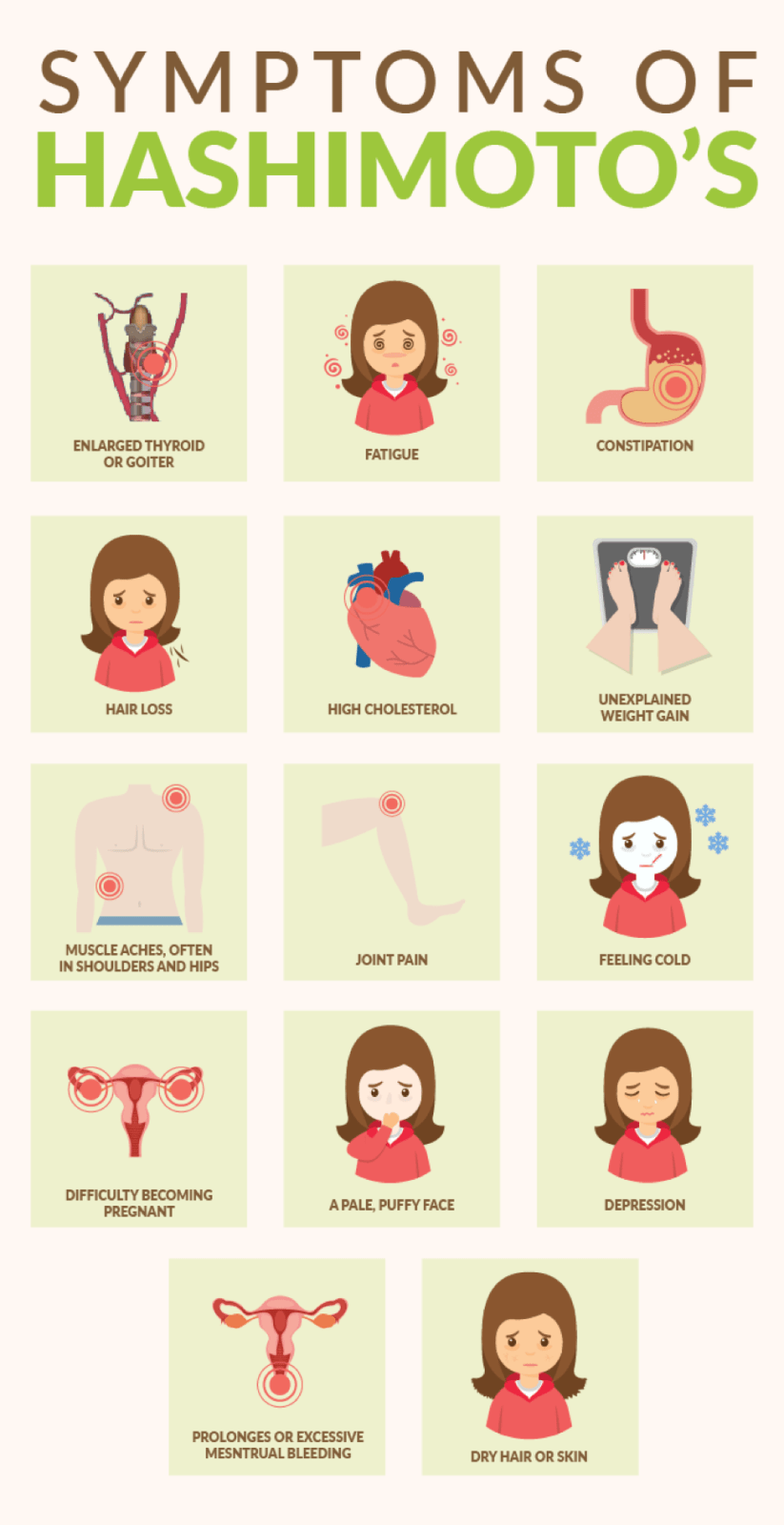
- Enlarged thyroid or goiter
- Fatigue
- Constipation
- Hair Loss
- High cholesterol
- Unexplained weight gain
- Muscle aches, often in shoulders and hips
- Joint pain
- Feeling cold
- Difficulty becoming pregnant
- A pale, puffy face
- Depression
- Prolonged or excessive menstrual bleeding
- Dry hair or skin
What Causes Hashimoto’s Disease?
While an exact cause is unclear, those who have or who have family members with other autoimmune diseases like lupus, rheumatoid arthritis, or type 1 diabetes are more likely to develop Hashimoto's disease. Leaky gut is also thought to be a contributing factor.
The most common autoimmune disease in the United States, Hashimoto’s disease affects more women than men and often follows pregnancy. It usually occurs during middle age.
As you will find out throughout this article, there are also a number of different things that can trigger this autoimmune disease. Environmental factors and even other imbalances in the body could be a hidden cause of Hashimoto’s. Without properly uncovering what may be causing Hashimoto’s in the first place it can be difficult to get well. This is where a functional medicine approach comes in.

Diagnosis
Diagnosing a thyroid condition can be tricky if you go to a modern medical physician, and you will find out why. For now, just know that if left untreated, hypothyroidism can lead to an enlarged thyroid or goiter, mental illness, heart problems and other complications. Babies born to mothers with hypothyroidism are at greater risk for birth defects and developmental issues.
A Doctor of Functional Medicine can perform hormone and antibody tests to evaluate the health of your thyroid. A functional medicine approach also takes a more holistic approach when determining what the underlying cause of Hashimoto’s is and may be able to diagnose the condition before certain lab tests may even be able to pick up on it.
If you have been diagnosed with Hashimoto’s or have been trying to determine what is causing all of your symptoms I am going to share the difference between the traditional medical option for Hashimoto’s VS the functional medicine approach. Both are quite different, especially when it comes to diagnosing this condition.
Traditional Medical Options for Hashimoto’s
Many of the patients that I see come to me after they have been down the modern medical route many times before. Some patients have already been diagnosed with Hashimoto’s while others suffer from many of the classic symptoms but are told that their lab values are within the “normal” range.
Unfortunately, the traditional medical options for Hashimoto’s are often disappointing as they leave lots of room for missing a diagnosis. The pathologic lab values are likely the lab values your physician uses when they order blood work. The problem with this is that the ranges are far too broad and can easily miss a Hashimoto’s diagnosis. This is just one of the many things that separate a traditional approach of looking at disease when compared to a functional medicine approach to working with patients.
Traditional medical options also almost always include a prescription medication of some sort. Now, while some patients will absolutely need to take their thyroid medication, there are other modalities that can be used along with that medication to help the patient feel better long term.
There are many different things about the modern medical world that makes many patients frustrated and leads them towards wanting to take a more holistic approach to their health.
Let’s take a look at this approach and how it may benefit you.
Functional Medicine Options for Hashimoto’s
A functional medicine approach is much different than traditional medicine in many different areas. The first area it's different is apparent during the very first interaction with a patient. In functional medicine, we take a holistic and participatory approach to wellness, so we encourage our patients to be a part of the process. This includes involving them in what tests should be run and including each patient is the various different options that are available.
Let’s start by talking about testing. In functional medicine, we look at much more than just a single lab test. Plus, when we do run bloodwork we use the functional lab ranges which are not nearly as broad as the pathological ranges so it allows us to see if there is a thyroid issue going on earlier than other blood tests may detect.
We also look at more than one test and take symptoms into account. How many times have you been to the doctor describing unbearable symptoms only to be told that they are all in your head because every test they run turns out to be “normal?” This is something I see on a daily basis and something that can be extremely discouraging to patients. Even if your previous lab work has come back within normal range, as a Functional Medicine Practitioner, I take all symptoms into account to help uncover what may be going on.
A functional medicine approach also looks at different body systems, not just the thyroid to see where the root cause of the issue may be. I am going to talk more about the tests offered coming up, so keep reading.
How We Can Help
We first evaluate underlying causes such as stress, gut infections, adrenal gland dysfunction, dysglycemia (high or low blood sugar), individual food sensitivities and other contributing factors. By determining your triggers through a variety of tests, we can determine a natural course of support toward healing that is specific to what your own body needs.
It’s important to know that there may be a number of different triggers and uncovering them is a huge step in feeling better. Let’s say we uncover a gut infection; we would work towards ridding the body of that infection first or even in conjunction with a protocol for Hashimoto’s. If there is an imbalance elsewhere in the body that is triggering Hashimoto’s, then it’s important to address that at its source and start a very specific protocol tailored to you.
Tests Offered
When any patient with Hashimoto’s symptoms comes to my practice, I always run thorough testing. It doesn’t matter if you have already had lab tests run by your doctor as you now know that many of these tests are read using broad lab ranges. Here are some of the comprehensive tests I offer in my practice to help determine what the underlying cause of Hashimoto’s is.
- Complete thyroid panel
- Food sensitivity testing
- Gut infection testing
- Heavy metal testing
- Adrenal gland tests
- Blood sugar testing

When all of these tests are run, it allows us to take a look at the entire body and how well it is functioning and what needs work. When thorough and complete tests are run it gives us a whole-body picture as to what could be triggering the autoimmune condition. This will ultimately help us get it under control and keep it under control.
Using a functional medicine approach is not about putting a Band-Aid on your symptoms. It’s about finding out what is causing your symptoms so that remission is possible long term.
Prognosis
Once we have identified your triggers, you can get the gene to change its expression or shut off (known as epigenetics). When this happens many, if not all, of the symptoms being caused by this, can disappear. The key to keeping this at bay is to manage stress and maintain a healthy diet & lifestyle.
Since each person is unique, specific dietary and lifestyle recommendations will vary. For example, while one person may do well with one particular food in their diet another person may have a sensitivity to it. The same goes for if there are gut infections or other imbalances going on in the body that need to be addressed as part of the protocol. The action steps I am listing below for taking control of Hashimoto’s are general recommendations. Bear in mind that each and every person will need a bit of a different approach depending on what is going on in the body.
To start taking control of your Hashimoto’s, take a look at the action steps below that you can implement to hopefully start to feel better, and to take control of your health.
Take Control of Hashimoto’s
There are a variety of steps you can take to take control of your Hashimoto’s and regain your health. Here is what I recommend:
Get Testing for Hashimoto’s
Get proper testing to uncover the root cause of your symptoms and thyroid issues. A functional health practitioner, like myself, can help you to recommend and arrange proper testing.
Eliminate Any Reactive Foods
Eliminate any foods that trigger your symptoms or make you feel sick. Trying an elimination diet may help you to uncover your triggers. A functional health practitioner can help you with that.
Start a Paleo-Style Diet
For Hashimoto’s disease, I recommend a Paleo-style anti-inflammatory diet. Remove inflammatory foods, including refined sugar, refined oil, gluten, conventional dairy, artificial ingredients, and processed food. Eat plenty of greens, vegetables, herbs, spices, fermented food, low glycemic index fruits, healthy fats, and clean animal protein.
Try a 30-Day Thyroid Reset
If you have Hashimoto’s disease or another thyroid disease, I recommend reading and following the recommendations in my book, The 30-Day Thyroid Reset Plan: Disarming the 7 Hidden Triggers That are Keeping You Sick. You will learn everything you need to know about thyroid disease. I offer a 30-day plan to improve your health and my favorite thyroid-friendly recipes to nourish your body with delicious meals.
Reduce Stress
Lower your stress levels and learn to cope better with stress. Try meditation, journaling, breathwork, nature walks, coloring, stretching, gratitude, and yoga.
Improve Your Sleep
Make sure to sleep at least 7 to 9 hours at night. Develop an evening routine that relaxes your body and calms your mind. Avoid electronics and food close to bedtime and engage in relaxing activities
Stay Active
Live an active lifestyle as it is appropriate to your body. If you can, exercise 5 days a week for 20 to 30 minutes incorporating both cardio and strength training. Stay active throughout the day by taking walks, dancing to your favorite songs, gardening, or playing with your kids and pets.
When following these steps, keep in mind that each person will be different and I always work with each patient on an individual basis to determine which form of exercise will work best for them. With any autoimmune disease, it’s important to find the right balance where you are not doing too much, but you are doing enough to keep yourself healthy.
While finding out that you have Hashimoto’s can be confusing, frustrating, and make you feel completely overwhelmed know that there are many steps that you can take. Even if you end up on thyroid medication, including a functional medicine approach into your plan is only going to help keep symptoms at bay long term.
Hashimoto’s is a complex condition and takes a professional who has lots of experience to really dive into the true cause and to help create a plan that is unique to you. It’s important to know that it takes many different approaches to get Hashimoto’s into remission and that unfortunately, there is no one size fits all. For example, you can’t just eliminate gluten and feel completely better. It takes a whole-body holistic approach to address both the physical and mental aspects of health and wellness. However, with just a little effort and some adjustments to your diet and lifestyle, you could be well on your way to feeling better and living your best life.
I have worked with patients who have been able to come off of their thyroid medication and have worked with patients who were able to be diagnosed early enough to where medication wasn’t necessary. No matter what the case, for you, know that a holistic approach is a way to approach this autoimmune condition and that with the right steps you could be feeling better fast.
Final Thoughts
Hashimoto’s disease is a common autoimmune thyroid condition. However, if you have Hashimoto’s you don’t have to deal with uncomfortable symptoms for the rest of your life. Follow my tips to improve your thyroid health and regain your health and wellness naturally.
If you are dealing with symptoms of Hashimoto’s disease or other thyroid issues, I invite you to schedule a consultation with me. I can help to identify the root cause of your condition and recommend a personalized treatment plan to repair your body and regain your health and well-being. Schedule your consultation here.
[sc name="Below all post"]

The Paleo Approach for Kids
I am dedicating a large part of this year to working with busy moms who want to feel and look their best and stay active with their kids. A large part of being able to keep up with the kids involves meal prepping like a pro and of course, fueling your children’s bodies right! A well fed and healthy child is much more likely to have better sleep habits, better performance in school, and improved mood. This is where Paleo for kids comes in.
Nutrition for our children is such an important topic and one that is not talked about nearly enough. There are so many mixed messages as to what we should be feeding our children. From the TV commercials to what is fed in school cafeterias. It's no wonder the messages get mixed up.
Just as I recommend a Paleo approach for my patients, I also recommend a Paleo style diet for my patient's children. Keep reading because I am going to explain why.
Let’s start by talking about the problem with what is currently being fed to the vast majority of the kids in the United States today.
The Problem with the Way Our Kids Eat
You know those cereal commercials, or the milk ads claiming to help start your child’s day off on the right foot and support growth? Well, those same products are often packed full of sugar and artificial ingredients.
Did you know that the average children’s cereal contains an average of 2 ½ teaspoons of sugar? This means that the average child who consumes sugary cereal each day would consume approximately 1,000 teaspoons of sugar in one year! (1) That’s just coming from the cereal. This does not take into account the other sources of sugar found throughout the day such as packaged snacks, processed foods offered at school, and dessert.
Now, I know that the topic is controversial and some people feel as if children should experience sugary foods as part of their childhood. Unfortunately, these foods are highly addictive, contain toxic ingredients and can certainly lead to blood sugar imbalances, sleep disturbances, decreased performance in school, and in some cases can even lead to obesity.
While our culture is so accustomed to purchasing packaged snack options, sugary beverages, and takeout food, there are so many healthier options we can be feeding our children. Don’t worry about your kids missing the junk food! I am going to share some great tips on how to slowly transition them to a Paleo way of eating so that they don’t feel deprived. You would be surprised at how adaptable little one's palates are and how quickly they may prefer the real food option over the processed bag of chips.
The Paleo Way for Kids
So, what makes the Paleo approach for kids such a great way to feed our kids for optimal health? A Paleo style diet is one that removes inflammatory foods and focuses on the foods that our ancestors once ate. It eliminates processed and artificial foods and keeps sugar, gluten, and dairy out of the diet. What you are left with is an incredibly nutrient dense diet to support your child’s overall health.
Let’s take a look at some of the benefits of adopting a Paleo approach for the entire family.
The Benefits of Paleo for Kids
- Fat & Iron: Kids need nutrient dense foods to grow. Children also need fat and iron for proper brain development. Fat is also needed to help build nerve tissue and help with the absorption of fat-soluble vitamins. Iron is needed for proper body function. Most packaged “kids” foods are not rich in iron or fat. A Paleo approach encourages the intake of healthy fats as well as high-quality protein to support proper brain and body development in children.
- Grain & Gluten Free: While being grain and gluten free does not automatically make a diet low-carb, it does eliminate things like processed and refined carbs that are linked to obesity and diabetes. The CDC states that obesity affects 1 in six children in the US today. (2) Diabetes and insulin resistance are also on the rise. With high processed carbohydrate intake, this number with continue to grow. However, when you follow a Paleo style diet, you encourage the consumption of foods that help to naturally balance blood sugar levels instead of spiking them.
- Low in Gut Irritating Foods: The processed and packaged foods that are made available to our children today are recipes for gut health disaster. The high sugar foods can lead to gut health imbalances, not to mention sugar addictions. A Paleo style diet eliminates many of the gut irritating foods (grains, gluten, dairy, sugar) which means your child is more likely to have an optimal functioning digestive system. This is incredibly important because gut health is at the center of overall health. We can’t be truly healthy unless we get our gut health in check.
- High in Nutritional Value: On top of all of the great healthy fats and quality proteins your child will get on a Paleo diet, there are also lots of vegetable and low sugar fruit options. This diet is a great way to pack in lots of nutrient dense foods into your child’s diet.
How to Ease Your Kids into a Paleo Diet
I have compiled a list of tips that I have found to be very helpful for parents who are looking to transition their entire family to a Paleo style diet. These tips are practical and make it easier than making a massive shift overnight. It helps to gradually introduce new foods while eliminating the processed foods from the diet.
#1 Eliminate the Easy Foods First: Start by eliminating things like take-out pizza, mac and cheese, bread, and cereal.
#2 Replace with Healthy & Tasty Alternatives: Instead of the sugary cereal, make some Paleo approved granola with some soaked nuts, grade B maple syrup, and cinnamon with a splash of almond milk. Instead of mac and cheese, make a butternut squash mac and cheese sauce poured over spaghetti squash. For dessert, make a “fat bomb” using coconut oil mixed with some raw unsweetened cocoa powder and almond butter.
#3 Choose Snacks Wisely: Snacks are where many families have difficulty. That’s because there are so many poor kids snack choices available it’s hard to truly avoid them all. Always have some unsweetened coconut yogurt around or just some coconut cream and mix that with some berries and raw honey. Another great snack option is an almond milk based smoothie with some berries, avocado, and coconut oil.
#4 Make Dinner Easy: Parents often struggle with finding a balance between making a healthy dinner and not having enough time or energy to make something nutritious. A great way to get around this is to use a crockpot to toss in some grass-fed beef, chicken, lamb, or whatever meat your family likes. Add some bone broth, veggies, herbs, and spices. A crockpot is a great way to save time on cooking but also to pack in some healthy nutrition into your family’s diet.
We have to take charge and change the way our kids eat today. Make small changes to start and before you know it you will have the whole family switched to this way of eating! Taking the step now is an excellent way to safeguard your family’s health for the future.
If you are suffering from weight gain, fatigue, hair loss and more, click here to schedule a phone call with me, so I can find out where you’ve been, where you want to get to, and how I can help you get there.
I know exactly where you are because I’ve been there myself…I remember being so tired that I could barely function. I gained 30 pounds out of nowhere and had a severe case of brain fog. I also started to get severe anxiety and panic attacks. I was driven and motivated…until I wasn’t. I didn’t know what was happening to me. All I wanted was to get my life back…
Finally, I learned about functional medicine and found a practitioner that I hoped could help me. They ran specialized tests that were far different than I had ever had before. When I got the results back, it turned out I had candida, parasites, high cortisol, the Epstein Bar Virus and many food intolerances. I also had an issue with my thyroid that no one found before because they were using the conventional medicine lab ranges which are way too broad….which I now know is one of the leading causes of hypothyroid misdiagnosis.
I went through treatment of all of these things and it completely changed my life. I immediately lost the 30 pounds I had gained plus more, I had a lot more energy, and my brain fog was gone. I felt amazing and knew that I wanted to help people find the underlying causes of their symptoms and disease.
Resources
EWG.org. (2014) Children’s Cereals: Cereals Contain Far more Sugar Than Experts Recommend.
Mandy Pagano. Keto Vangelist. Keto and Kids
[sc name="Below all post"]